All-American Play
Baseball history is defined by its legendary moments—arguably more so than any other sport. From Babe Ruth’s “called shot” in the 1932 World Series, and Willie Mays’ iconic over-the-shoulder catch in 1954, to Kirk Gibson’s hobbled walk-off home run in 1988, there is no shortage of unforgettable highlights across the regular season and postseason.
However, one of the most significant moments in baseball history doesn’t feature a Hall of Famer hitting a home run or making a spectacular defensive play. Instead, it involves a player whose actions were defined by his love for his country and what it stands for.
Robert James “Rick” Monday was born in Batesville, Arkansas, and later moved to Santa Monica, California. There, he earned all-league honors in high school, facing a pivotal decision: turn professional or attend college. While former Los Angeles Dodgers manager Tommy Lasorda offered Monday a $20,000 signing bonus to turn pro, Monday chose to enroll at Arizona State University.
The decision to become a Sun Devil paid off. During his 1965 sophomore season, he led the team with a .359 batting average and 34 extra-base hits. He earned All-American honors and helped lead Arizona State to a National Championship victory—ironically, over my own Ohio State Buckeyes. That same year, Monday became the first overall selection in the inaugural Major League Baseball amateur draft, chosen by the Kansas City Athletics.
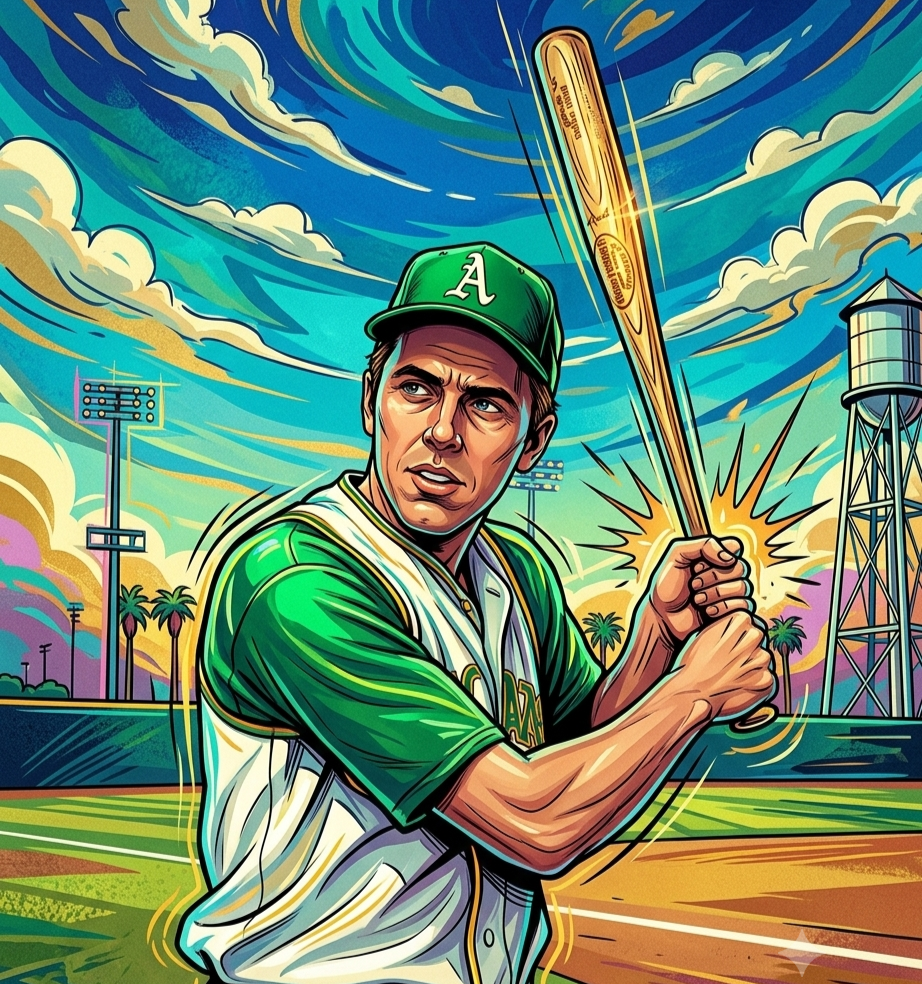
Monday began his professional career in the Single-A Northwest League with the Lewiston Broncs. Following that season, he and teammate Dave Duncan made the decision to enlist in the United States Marine Corps Reserve. Monday’s commitment stemmed from his time in the Reserve Officers’ Training Corps at Arizona State, which carried a six-year service obligation.
Serving in the reserves while playing Major League Baseball was a common practice for many notable athletes of that era, including:
Sandy Koufax and Don Drysdale: U.S. Army Reserve (1957–1959)
Roberto Clemente: U.S. Marine Corps Reserve (1958–1964)
Johnny Bench: U.S. Army Reserve (1966–1972)
After his time in Idaho, Monday played Double-A ball for the Mobile A’s in Alabama, where he was one of five players promoted to the big leagues that September.
Starting in 1967—the franchise's final season before moving to Oakland—Monday became a regular everyday player for the Athletics.
In his five seasons with the Athletics, Monday showcased why he was the first-ever overall number one draft pick. He posted a .267/.361/.427 slash line with 538 hits, including 62 home runs, 254 RBIs, and a .788 OPS.
He was named an All-Star in 1968 and helped lead the Athletics to the American League Championship Series in 1971, where the team was swept by the Baltimore Orioles. Following the 1971 season, Monday was traded to the Chicago Cubs for pitcher Ken Holtzman.
Monday continued his success in Chicago, posting a .270/.371/.448 slash line with 545 hits, 74 home runs, 216 RBIs, and an .819 OPS from 1972 through 1975. However, he would truly cement his legacy during a game in early 1976.
After splitting the first two games against the Dodgers in Los Angeles, the Cubs entered the April 25 rubber match with a 6–7 record, while Los Angeles held a 4–9 record. Monday led off for the Cubs that Sunday afternoon; he hit a fly ball to center fielder Henry Cruz in the first inning for an out, and bunted for an infield single past pitcher Rick Rhoden in the third.
Then came the infamous bottom of the fourth inning.
While patrolling center field after Cubs pitcher Ken Crosby induced a pop-out from Dodgers second baseman Ted Sizemore, Monday noticed something out of the corner of his eye.
“I turned, and I saw there were two guys on the field. They were running in my general direction, somewhere from the left-field foul pole,” Monday said in a Los Angeles Times article.
“I saw one of them had something under his arm. I couldn’t see what it was. I was irritated to begin with because they stopped the game,” Monday added.
“I’d seen other people run onto the field over the years, for whatever reason. People run out and shake your hand and continue running. But I saw these guys. When they came to a stop, one guy pulled out an American flag.”
Fans at Dodger Stadium took notice of the delay, and Monday knew he had to act.
“They put it on the ground. I can see the guy pull out something real shin[y]. It turned out to be one of those gigantic cans of lighter fluid. They were dousing it,” Monday said.
“The wind blew the first match out, I believe, or it went out on its own. The guy struck the second match about the same time I got there. But, if they don’t have the flag, they cannot burn it. So I scooped down and got the flag,” Monday added.
After grabbing the flag, Monday handed it to Dodgers pitcher Doug Rau, who had come out of the dugout.
“Tommy Lasorda, who was then the third-base coach, ran past me, yelling everything a longshoreman would utter on a bad day at those two guys,” Monday said.
Following the incident and the removal of the trespassers, Monday came to bat in the top of the fifth inning with the Cubs trailing 4–1. As he stepped to the plate, he received a standing ovation from the Dodger faithful as the scoreboard flashed: “Rick Monday: You made a great play.”
“If you’re going to burn the flag, don’t do it around me. I’ve been to too many veteran’s hospitals and seen too many broken bodies of guys who tried to protect it,” Monday said following the Cubs’ 5–4 loss that day.
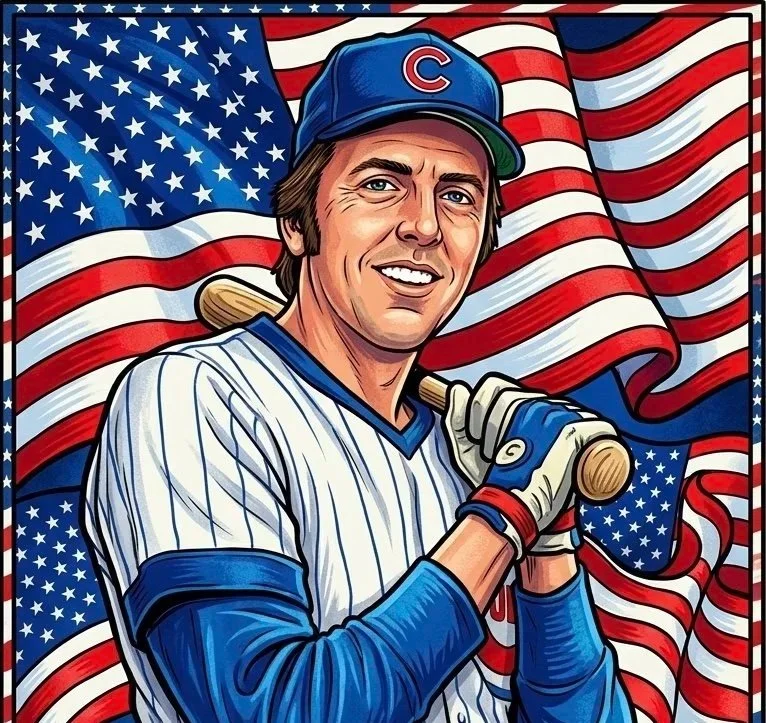
Following his heroic act, Monday received a congratulatory call from President Gerald Ford and an invitation to the White House.
That incident propelled Monday to the best season of his career. In 1976, he posted a 4.4 WAR across 137 games, recording 145 hits, 32 home runs, and 77 RBIs, while finishing 18th in NL MVP voting. He was traded to the Dodgers the following season, where he played his final seven years, helped the team win the 1981 World Series, and retired in 1984.
Over his 19-year career, the two-time All-Star finished with 33.1 WAR, 241 home runs, and 775 RBIs. Yet, despite these respectable statistics, Monday remains best known for his dash to save the American flag at Dodger Stadium in April 1976.
After legal proceedings concluded, Monday was granted ownership of the flag. He has since used it to honor the nation, telling MLB.com, "It still catches a glimmer of attention for our country... I was just a spokesman that afternoon for thousands and thousands, if not millions, of people."
Monday revealed that he and his wife, Barbaralee, had toured the country with the flag, raising over $500,000 for military charities. He still receives weekly letters from admirers—many of whom weren't even born in 1976.
"I’m also embarrassed by the attention," Monday told the Los Angeles Times, "because I don’t know anyone that would not have done the same thing."
His humility stands in contrast to the current social landscape. A survey from April 2026 indicates that many people feel a sense of fragmentation in society, yet 80% still view veterans as symbols of core values like service and commitment. Furthermore, respondents identified the U.S. flag as the icon that best represents the nation—ranking it above the Statue of Liberty and the White House.
Perhaps Rick Monday and his actions can help renew our sense of common ground, echoing the astonishment Vin Scully felt in 1976: “I think a guy was going to set fire to the American flag. Can you imagine that?”
As we look back on that moment, his swift intervention reminds us that even when people have differing viewpoints, a shared reverence for our values can serve as a lasting bridge.